- All
- Product Name
- Product Keyword
- Product Model
- Product Summary
- Product Description
- Multi Field Search
Views: 0 Author: Site Editor Publish Time: 2026-09-22 Origin: Site

You have just finalized a stunning kitchen renovation. The quartz countertops gleam under recessed lighting, and the custom cabinetry aligns flawlessly. Then, the installation crew delivers a harsh reality: your brand-new cooking appliance simply will not fit into the designated cavity. Upgrading your kitchen with a sleek, modern appliance is an exciting milestone. Yet, purchasing the wrong size or mismatching technical specifications frequently leads to costly carpentry adjustments and frustrating project delays. With countless models flooding the market, buyers often feel overwhelmed by varying electrical requirements, complex heat management systems, and endless feature lists.
For standard residential homes and commercial property developments, a 60-liter capacity hits the absolute perfect sweet spot. It provides ample interior cooking volume for daily meal preparation and holiday gatherings without dominating the physical footprint of the kitchen. However, before you sign off on a final kitchen design or request a bulk quote for a multi-unit project, strict verification is mandatory. This technical checklist will guide you through the exact dimensions, power loads, and core cooking technologies you must evaluate to ensure your new Built-in Oven integrates seamlessly and safely into your infrastructure.
Dimensional Accuracy: Verifying your specific cabinet's internal cut-out dimensions against the appliance chassis is the single most critical pre-purchase step.
Electrical Infrastructure: Always audit the voltage, wattage, and amperage of your kitchen circuit. High-power units strictly require professional hardwiring rather than a standard plug.
Thermal Technology: Prioritize models equipped with dedicated fan-assisted elements to guarantee even heat distribution and faster roasting cycles.
Maintenance Efficiency: Specify easy-cleaning features like smooth enamel coatings or catalytic liners to drastically reduce manual scrubbing time.
Safety Standards: Ensure the unit features multi-layer cool-touch exterior glass and tangential cooling fans to protect adjacent cabinetry from heat degradation.
Unlike freestanding cookers that simply slide into an open gap between countertops, a built-in appliance must dock perfectly into a pre-existing or custom-built cabinet void. Measuring incorrectly by even a single millimeter can result in the appliance protruding awkwardly or failing to secure properly to the mounting brackets.
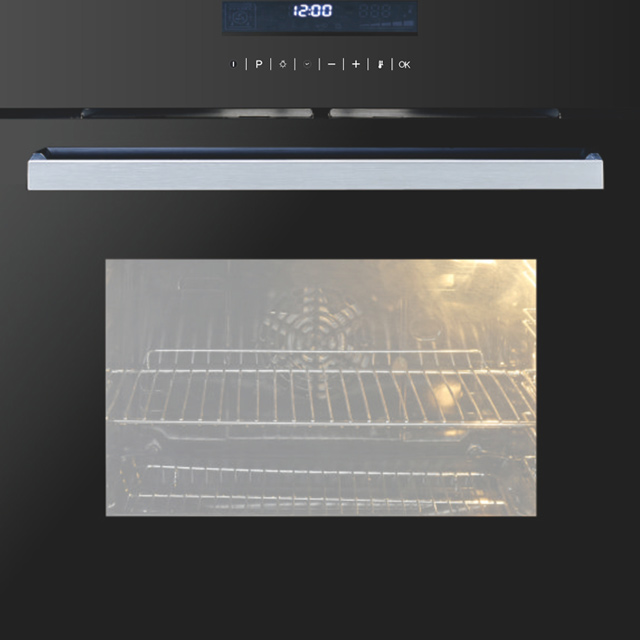
It is vital to understand the structural distinction between the exterior fascia of the machine and the internal cut-out dimensions required inside the wood cabinet. Standard 60-liter units typically feature a front glass fascia measuring precisely 595mm by 595mm. This design creates a flush, seamless aesthetic with standard 600mm wide cabinetry. Nevertheless, the actual metal chassis that slides into the wall is intentionally smaller.
To eliminate installation guesswork, cross-reference your space with this standard specification matrix:
Specification Area | Standard Measurement | Engineering Note |
|---|---|---|
Front Fascia Dimensions | 595mm (W) x 595mm (H) | Designed to overlap the cabinet edges for a flush finish. |
Cabinet Cut-Out (Internal) | 560mm (W) x 590mm (H) x 550mm (D) | Always verify exact depth to account for rear plug sockets. |
Rear Ventilation Gap | 35mm to 50mm minimum | Crucial for heat dissipation; prevents thermal fuse tripping. |
Beyond the physical fit, generating intense heat requires responsible airflow management. Proper ventilation is a non-negotiable safety requirement. Industry installation guidelines dictate leaving a substantial gap at the rear of the cabinet. If this trapped hot air cannot escape, the internal thermal fuse will likely trip mid-roast to prevent a fire hazard. Over time, poor ventilation will also warp and damage surrounding melamine cabinetry.
When evaluating technical specifications, buyers often wonder what a 60-liter interior volume actually translates to in practical culinary scenarios. Choosing a unit that is too small heavily restricts menu options, while an oversized cavity wastes expensive electricity heating empty space.
In terms of daily usage, this specific capacity is highly versatile. It provides enough vertical clearance to utilize multiple shelf positions simultaneously. Imagine prepping for a large weekend dinner party. This interior space comfortably accommodates a standard 15-pound turkey. Alternatively, you can easily bake two large trays of pastries at the same time, or roast a whole chicken on the middle rack while crisping a side dish of root vegetables on the bottom shelf.
Market data suggests that this size remains the global industry standard for very good reasons. It is the optimal capacity for medium-sized households comprising three to five members. Furthermore, for property developers and landlords, this specification is the safest structural bet. It fits universally into standard kitchen base units or wall towers, making it the most cost-effective and predictable choice for multi-unit residential projects.
Consequently, the invisible infrastructure of your kitchen demands equal attention to the physical cabinetry. Electrical mismatch is one of the most common reasons for appliance returns and frustrating installation delays. You must ensure your home distribution board can safely handle the sustained power draw of a high-resistance heating appliance.
Standard wattage ratings for a modern Electric Oven typically range between 2000W and 3000W. This depends heavily on the specific heating elements and premium digital features included. Before finalizing your procurement list, check your home electrical panel. The dedicated circuit for the kitchen must have the capacity to support the required amperage, which usually falls between 13A and 16A for appliances in this category.
Do not mistakenly assume your new appliance will simply plug into a standard wall socket. Lower-wattage models may come factory-fitted with a standard plug, allowing for a straightforward setup. In contrast, high-wattage models drawing above 3000W strictly require hardwiring. These robust units must be wired directly into a dedicated fused spur by a certified electrician to comply with strict local fire safety codes.
A high-quality appliance should offer genuine culinary versatility rather than just basic radiant heating. Buyers need to carefully review the function dial and heating specifications before placing an order to ensure the machine aligns with their daily cooking habits.
When reviewing technical sheets, prioritize models that feature true fan-assisted technology. A dedicated Convection Oven utilizes a motorized fan located at the back of the cavity, surrounded by its own circular heating element. This mechanism actively pushes hot air into every corner of the interior. As a result, it eliminates frustrating cold spots and cooks food significantly faster than conventional radiant heating. It also allows you to bake fish and desserts on different racks simultaneously without their flavors cross-contaminating.
Advanced models on the market today, such as those featuring digital touch controls, elevate the user experience further. Look for intelligent interfaces that offer precise temperature management alongside must-have everyday programs. Essential modes include Top and Bottom Heat for traditional baking, a Full-Width Grill for browning meats, and a dedicated Defrost mode that uses ambient fan circulation to thaw frozen ingredients safely.
After a beautiful meal is prepared, post-dinner cleanup is often the most dreaded chore. The materials and technologies used inside the cavity make a massive difference in the appliance lifespan and your daily ease of use.
Entry-level to mid-range models usually feature a smooth enamel interior. High-quality enamel is non-porous, actively preventing grease and sticky food particles from permanently bonding to the walls. For those seeking less manual labor, catalytic liners are a brilliant upgrade. These textured, porous panels are installed directly onto the interior walls. When heated above 200 degrees Celsius during normal roasting, they automatically absorb and oxidize fat splatters, leaving behind a fine ash that simply wipes away.
Additionally, check if the unit features a tool-less removable door mechanism. The ability to easily unhinge the door and slide out the inner glass panels allows for deep cleaning in the sink, keeping the appliance looking brand new for years without requiring harsh chemical sprays.
Safety is absolutely paramount, particularly when an appliance capable of reaching 250 degrees Celsius is installed at eye-level or tucked under a counter in a bustling household.
Standard models come equipped with double-glazed doors, which are generally sufficient for basic use. However, for enhanced peace of mind, seek out triple-glazed glass configurations. These multiple layers, combined with heat-reflective coatings, trap cooler air between the panes. This ensures the exterior fascia remains warm rather than dangerously hot during operation.
Equally important is a tangential cooling fan. Operating entirely independently of the main internal cooking fan, it pulls room-temperature air through the exterior metal chassis. This continuous airflow keeps the electronic touch control board cool, thereby protecting your wooden cabinetry from heat degradation, warping, and discoloration over time.
Recent industry analyses reveal a massive paradigm shift in kitchen appliance procurement. Modern property developers and eco-conscious consumers are moving rapidly away from basic heating units toward highly insulated, energy-efficient models. Stricter global energy regulations mean that installing appliances with advanced thermal retention is no longer just a premium upgrade; it is a baseline requirement for maintaining real estate value and reducing long-term grid reliance.
Because heating elements naturally draw significant electrical power, the energy efficiency of your appliance directly impacts your household utility costs. In many regions, appliances are graded using the standard A to G grading scale. Buyers should always aim for a unit with at least an A rating. These advanced models utilize superior fiberglass insulation, highly reflective inner glass, and optimized digital heating algorithms. By retaining heat more effectively within the cavity, the appliance draws significantly less electricity to maintain target roasting temperatures.
For a buyer ready to make a financial commitment, reassurance regarding post-purchase support is often the deciding factor. An appliance is a long-term structural investment, and reliable after-sales infrastructure is critical.
Before finalizing your transaction, meticulously review the warranty terms. A reputable manufacturer should offer a comprehensive warranty covering both parts and labor. Ensure you understand whether expensive components like electronic touch control boards are covered. Furthermore, sourcing from established suppliers guarantees strict quality control processes and international safety certifications including CE or CB standards. A proven manufacturer will also maintain an accessible inventory of spare parts, ensuring a minor component failure years down the line can be swiftly repaired.
Measuring your exact cabinet cut-out space is your first and most critical step. From there, always confirm your home electrical compatibility to avoid severe installation hazards. By selecting the right convection features for superior cooking performance and ensuring the unit has robust safety and maintenance options, you safeguard both your time and your culinary results.
Ultimately, a carefully selected 60L built-in electric oven is a fantastic long-term investment. It blends seamlessly into modern kitchen aesthetics while delivering reliable cooking power for years to come. Review your kitchen specifications one last time, consult the technical data sheets, and explore high-quality, certified models at Jiaye World to find the absolute perfect match for your next residential or commercial project.
While exact dimensions can vary slightly depending on the specific brand and model, the standard cabinet cut-out requirement for a 60-liter unit is typically 560mm in width, 590mm in height, and 550mm in depth. It is imperative to always check the specific manufacturer installation manual before cutting or altering any kitchen cabinets.
Yes, for the vast majority of users, it is highly superior. A convection model utilizes an internal fan to actively circulate hot air throughout the cavity. This technology eliminates cold spots, cooks food up to 25 percent faster than conventional heating, and is perfect for baking multiple trays of food at once without the risk of flavor transfer between dishes.
Absolutely. A built-in appliance is specifically designed for flexible installation. It can be installed either in an eye-level wall cabinet, which provides ergonomic access without bending, or it can be installed under a standard kitchen counter, typically directly beneath a matching induction cooktop.
This depends entirely on the specific power rating. If the appliance is rated below 3000W, it may come equipped with a standard plug for simple installation. However, higher-wattage ovens draw too much current for a standard socket and require hardwiring to a dedicated electrical circuit. This hardwiring process must be completed by a certified electrician to ensure safety and compliance with local building codes.
Conventional settings rely on stationary heating elements at the top and bottom of the cavity, which can lead to uneven temperatures. A convection setting activates a motorized fan that continuously circulates the heated air. This forced airflow ensures a uniform temperature throughout the entire cavity, resulting in faster cooking times and crispier exteriors on roasted foods.
Professional installation guidelines strongly recommend leaving a continuous gap of at least 35mm to 50mm between the back of the appliance and the rear wall of the cabinet. This crucial ventilation channel allows the intense heat generated by the chassis to escape, preventing the internal safety thermostat from tripping and protecting your cabinetry from heat damage.