- All
- Product Name
- Product Keyword
- Product Model
- Product Summary
- Product Description
- Multi Field Search
Views: 0 Author: Site Editor Publish Time: 2026-09-16 Origin: Site

Why do classic kitchen designs still dominate global sales? The traditional chimney shape remains a highly profitable staple for home appliance brands worldwide. Sourcing appliances overseas, however, carries hidden risks. Importers must verify strict specifications to protect margins and build brand equity. In this comprehensive guide, buyers and brand owners will learn the exact requirements to successfully navigate a custom manufacturing project. We will cover everything from factory vetting to customized aesthetic finishes.
Recent industry analyses indicate a noticeable shift in global procurement strategies. While minimalist hidden ventilation systems gain traction in ultra-modern builds, the traditional exposed chimney style retains a dominant market share. This is particularly true in suburban residential developments and commercial-style home kitchens. Furthermore, fluctuating raw material costs have pushed importers to seek highly vertically integrated factories. Buyers are no longer just looking for assembly lines. They need manufacturing partners with in-house metal stamping and motor winding capabilities to absorb price shocks and guarantee stable lead times.
Size Matters: The 60cm variant is the most popular size for compact and standard kitchens. Offering both 60cm and 90cm ensures broader market coverage.
Material and Finish: Choosing the right stainless steel grade, like 304 versus 430, and trending finishes can significantly impact profit margins and target audience appeal.
Motor and Suction: Importers must balance high extraction rates with acceptable noise levels to meet consumer expectations and regulatory standards.
Certifications are Non-Negotiable: Ensure the manufacturing facility holds the specific safety and energy certifications required for the target country.
Factory Vetting: A successful project relies on a manufacturer with robust in-house testing, strict quality control protocols, and clear minimum order terms.
The pyramid shape maintains a timeless presence in kitchen architecture. Empirical market data suggests homeowners consistently gravitate toward this design. It offers a professional, commercial-kitchen aesthetic. Beyond visual appeal, the structural geometry of a Pyramid Cooker Hood serves a highly functional purpose. The broad base provides a massive capture area. This naturally funnels smoke, steam, and airborne grease upward into the extraction system. This fluid dynamic efficiency reduces the reliance on excessively powerful motors. You optimize energy consumption while maintaining highly effective ventilation.
Developing a completely new appliance from scratch involves substantial research expenditures, rigorous prototype testing, and lengthy certification processes. By choosing the established manufacturing route, importers can leverage existing, proven factory molds. This significantly lowers initial investment costs and accelerates time-to-market. Buyers can focus entirely on customizing the exterior branding, selecting specific internal components, and adapting features to meet local market demands. You avoid foundational engineering risks entirely.
Selecting the correct dimensions is critical for inventory turnover. Picture a standard European or South American apartment kitchen. Space is at a premium. This makes a compact 60cm Range Hood an absolute necessity. It aligns perfectly with standard four-burner cooktops, driving high-volume sales across urban demographics. Conversely, the 90cm variant is essential for larger five-to-six-burner stoves. These dominate North American households and global luxury real estate markets. Offering a strategic mix of both sizes ensures a brand can penetrate mass-market and premium segments.
While aesthetics draw the consumer in, functional performance ultimately secures their satisfaction. Motor performance directly dictates the functional viability of the appliance. Suction power is standardly measured in Cubic Feet per Minute for the North American market, or Cubic Meters per Hour for European and Asian markets. For standard residential applications, procurement managers should target an extraction range between 400 and 800 Cubic Meters per Hour. For instance, a reliable three-speed copper motor setup provides an excellent balance of power and durability. Importers must also decide between Alternating Current and Direct Current motors. Traditional Alternating Current motors are cost-effective. Direct Current motors offer superior energy efficiency and operate with significantly less vibration.
A common pitfall in appliance sourcing is prioritizing suction power while completely neglecting acoustic comfort. High extraction rates inherently generate more noise. This is a primary driver of negative consumer reviews. Objective testing indicates that a well-engineered ventilation unit should operate between 55 and 65 decibels at its maximum speed setting. Importers should mandate that factories utilize sound-dampening materials within the motor housing. Optimizing the internal airflow channels is also critical to mitigate turbulence-induced noise.
The longevity and perceived value of a kitchen appliance depend heavily on the metallurgy of its housing. Importers generally choose between two primary grades of stainless steel: Grade 430 and Grade 304. Grade 430 is magnetic, affordable, and perfectly suitable for dry, inland climates. On the other hand, Grade 304 is non-magnetic and highly resistant to corrosion. This makes it the premium choice for humid or coastal environments. Furthermore, the thickness of the steel is a critical specification. Procurement contracts should stipulate a minimum thickness of 0.5mm to 0.6mm for standard models, scaling up for premium lines. Thinner materials are highly susceptible to denting during ocean freight and installation. This inevitably leads to unacceptable defect rates upon arrival.
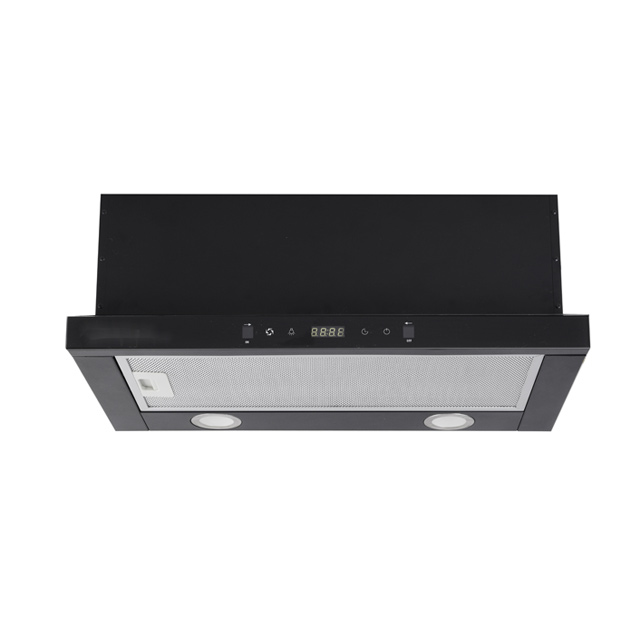
Consumer demand for modern, dark kitchen aesthetics has surged in recent years. Adding a matte Black Range Hood is a lucrative strategy for any product catalog. Achieving a durable dark finish requires precise manufacturing processes. Factories typically utilize high-temperature powder coating or electrophoretic painting over standard steel. For ultra-premium models, black stainless steel or tempered glass accents are employed. When sourcing these dark finishes, it is imperative to explicitly request anti-fingerprint nanocoatings. Without this protective layer, matte surfaces easily show grease and smudges. This leads to user frustration and increased warranty claims.
The user interface is the primary touchpoint for the consumer. It heavily influences the product market positioning. Factories offer several control module options to fit different price points. Mechanical push buttons are highly durable and resistant to electronic failure in humid environments. They are ideal for budget-conscious demographics. Touch controls with digital displays provide a sleek, modern aesthetic that is easy to wipe clean. For top-tier models, gesture controls utilize infrared sensors. This allows users to adjust fan speeds with a wave of the hand. It is a highly practical feature when hands are coated in food preparation residue.
Filtration efficacy determines how well the unit traps airborne grease before it reaches the internal motor cavity. Multi-layered aluminum mesh filters are cost-effective and highly efficient at trapping grease. However, they require frequent cleaning and can degrade over time. Alternatively, stainless steel baffle filters are modeled after commercial kitchen standards. They force air to change direction rapidly, separating grease through condensation. They are highly durable, dishwasher-safe, and visually appealing. If the appliance is intended for ductless installation, importers must ensure the factory includes active charcoal filters. These neutralize odors before recirculating the air.
Illumination is a critical functional requirement that enhances the cooking experience. Procurement managers should specify energy-saving LED lighting modules over outdated halogen bulbs. LEDs offer superior longevity, lower energy consumption, and cooler operating temperatures. Specifically, a 2-watt LED setup provides ample workspace illumination. Regarding branding, factories provide multiple customization zones. Standard practices include laser-engraved or silk-screened logos on the front stainless steel panel. You can also request customized boot-up screens for digital displays and localized user manuals tailored to specific market regulations.
Importing electrical appliances without the requisite regional certifications can result in catastrophic customs seizures, heavy fines, and severe liability issues. Industry trends show a tightening of global safety regulations. Importers must rigorously verify that the manufacturing facility holds valid certificates for the target market. For North America, compliance dictates the presence of Underwriters Laboratories or ETL marks. In Europe and the UK, CE marking, CB scheme certification, RoHS compliance, and the UKCA mark are mandatory. Meanwhile, Middle Eastern and Asian markets require specific national standards, such as SASO for Saudi Arabia or CCC for China.
For the European market, adherence to the Energy-Related Products directive is strictly enforced. Achieving an A or A+ energy class rating serves as a massive competitive advantage in retail environments. Eco-conscious consumers increasingly factor utility costs into their purchasing decisions. Securing this premium rating requires the factory to utilize highly efficient Direct Current motors, optimized aerodynamic internal housing, and low-wattage LED lighting. Importers should always request verifiable test reports during the initial supplier vetting phase.
A manufacturer reliability is heavily dependent on their internal quality control infrastructure. Whether conducting a physical factory audit or utilizing a third-party inspection agency, importers should verify the existence of advanced in-house testing facilities. Key indicators of a mature factory include dedicated airflow testing chambers to verify extraction claims. You should also look for soundproof rooms for accurate decibel measurement and salt-spray testing cabinets. These ensure the stainless steel housing can withstand prolonged exposure to humid, saline environments without rusting.
Assessing vertical integration provides deep insight into a factory ability to maintain quality consistency and scale production. Factories that punch their own sheet metal and wind their own copper motors generally offer more stable pricing. They provide stricter quality oversight compared to assembly-only workshops that outsource component manufacturing. Buyers should evaluate the automation level of the assembly lines. Look for robotic welding and automated laser cutting machinery. These drastically minimize human error.
Kitchen appliances are inherently fragile due to their sheet metal construction and internal electronics. Imagine a shipping container navigating rough ocean swells. Without adequate protection, the chassis is highly susceptible to irreversible dents. Importers must insist on drop-test certified packaging protocols. This requires the use of high-density EPS foam or reinforced honeycomb cardboard inserts. Pre-shipment inspections should always include a standardized drop test from varying heights and angles. This simulates the rigors of ocean freight and last-mile delivery.
When finalizing a project, the negotiation phase is the ultimate determining factor for long-term profitability and supply chain stability. In the global appliance manufacturing sector, the minimum order quantity is heavily dictated by the production constraints of metal stamping machines. For a standard project, factories typically require an order of 100 to 200 units per specific model. This generally aligns with the capacity required to fill a standard 20-foot shipping container. Importers launching a new brand can often negotiate a reduced volume for an initial trial order. You can achieve this by agreeing to standard, non-customized packaging or by utilizing the factory existing generic internal components.
Understanding container capacity is vital for calculating shipping efficiency and lowering the landed cost per unit. Most experienced procurement managers calculate their volumes based on a 40-foot High Cube container to maximize freight value.
Appliance Size | Standard 20-Foot Container Capacity | 40-Foot High Cube Capacity | Ideal Market Application |
|---|---|---|---|
60cm Model | 180 to 200 Units | 450 to 500 Units | European, Asian, and South American urban housing. |
90cm Model | 120 to 140 Units | 300 to 350 Units | North American, Australian, and luxury residential markets. |
Pricing for ventilation appliances is subject to raw material fluctuations. The global commodity prices of stainless steel and copper are primary drivers. Importers should request a detailed Bill of Materials breakdown. This helps you understand exactly what components drive the unit cost. Standard business-to-business payment terms usually operate on a Telegraphic Transfer basis. This requires a 30 percent deposit to initiate raw material procurement. The remaining 70 percent balance is paid against the copy of the Bill of Lading after goods have been shipped.
After-sales support is a vital component of brand equity. A reputable manufacturer will not simply ship the products and sever ties. They must provide the necessary infrastructure for warranty fulfillment. Importers should always proactively negotiate for 1 to 2 percent free of charge spare parts to be included within every container shipment. Securing these parts upfront prevents expensive international airfreight shipments later when a consumer needs a rapid replacement.
Component Type | Rationale for Inclusion in Spare Parts Agreement |
|---|---|
LED Light Modules | High frequency of burnout over time. Extremely easy for end-consumers to replace themselves. |
Push Button Switches | Prone to mechanical wear from daily use. Critical for the basic operation of the appliance. |
Control Boards | Vulnerable to local power surges. Essential for models featuring digital touch controls. |
Aluminum Mesh Filters | Subject to heavy grease accumulation, discoloration, and potential bending during manual cleaning. |
The industry standard for a manufacturing contract includes a one-year comprehensive warranty on the entire unit. You should also expect an extended three- to five-year warranty specifically for the motor, reflecting its expected operational lifespan. Importers must establish a clear Standard Operating Procedure for defective claims before signing the contract. Typically, the importer aggregates consumer defect reports and submits them quarterly. The factory then compensates the buyer via a credit note or by shipping replacement parts in the subsequent container. This ensures the importer does not absorb the financial impact of manufacturing faults.
Typically, manufacturers require an order of 100 to 200 pieces per specific model. This minimum is enforced because factories must purchase raw materials, such as sheet metal and motor components, in bulk quantities to maintain profitability. Setting up metal stamping machines for a specific chimney shape also requires considerable labor and time. However, the exact volume often depends on the container size. Most importers aim to fill a 20-foot container to optimize shipping costs. Some factories may negotiate a lower volume for initial trial orders if the buyer agrees to use standard internal components and generic packaging.
Yes, modifying a standard ducted hood into a ductless, or recirculating, system is a very common request. Most factories can adapt the unit by adding active carbon charcoal filters to the sides of the motor housing. In a ductless setup, the appliance draws in cooking exhaust, passes it through standard aluminum or baffle filters to trap heavy grease, and then forces the air through the carbon filters to neutralize smoke and odors before venting it back into the kitchen. Note that adding carbon filters slightly restricts airflow, potentially reducing the effective extraction rate by 10 to 15 percent.
The popularity of the size depends entirely on the geographical target market and typical housing infrastructure. The 60cm model is the undisputed best-seller in Europe, Asia, and South America due to high-density urban housing and standard four-burner cooktops. Conversely, the 90cm version is heavily preferred in North America, Australia, and luxury residential markets globally. Larger kitchens in these regions feature five-to-six-burner professional-style gas ranges requiring a wider capture area.
Yes, manufacturing a black unit incurs slightly higher production costs compared to standard brushed stainless steel. The most common and cost-effective method is high-temperature powder coating applied over cold-rolled steel. A more premium method involves Physical Vapor Deposition to create black stainless steel, which is highly durable but carries a steeper manufacturing cost. Despite the higher upfront expense, buyers frequently source dark models because they align with modern design trends, allowing brands to command a much higher retail markup.
A rigorous pre-shipment inspection conducted by a third-party quality control agency is critical. Inspectors generally follow Acceptable Quality Limit standards. The inspection should include an anemometer test to verify the motor actual extraction rate. You also need a decibel meter test to ensure noise levels remain within the 55 to 65 decibel range. Electrical safety checks like Hi-Pot and earth continuity tests are mandatory. Visually, inspectors must check for scratches and verify touch controls. Finally, a standardized drop test must be executed on the carton to guarantee the internal foam will protect the chassis during rough ocean transit.
To accurately verify the extraction rate, the factory must test the unit inside a sealed aerodynamic chamber using professional airflow measurement equipment. During a factory audit, an engineer will measure the air velocity at the exhaust outlet and calculate the total volume moved per hour. Relying solely on the motor specification sheet is risky, as internal housing turbulence and filter density can significantly reduce the actual functional airflow. Always request a formal airflow test report for your specific model configuration.
For a first-time order involving custom branding and packaging, the standard lead time is generally 35 to 45 days after the initial deposit is received and all artwork is confirmed. This allows the factory time to procure specific raw materials and print customized cartons. For subsequent repeat orders where molds and packaging designs are already established, the lead time usually drops to 25 to 30 days. However, importers should always factor in an additional buffer during peak manufacturing seasons, such as the period leading up to the Lunar New Year.
Sourcing a high-quality ventilation appliance requires careful planning and rigorous engineering oversight. Importers must strictly control all technical specifications, from motor extraction rates to stainless steel thickness, to ensure a highly profitable product line. Partnering with a certified, vertically integrated manufacturer provides the transparency and consistent product quality needed to build lasting brand trust. Careful factory vetting prevents costly supply chain mistakes and safeguards your investment. If you are ready to elevate your product catalog with reliable, high-performance appliances, explore the extensive selection at Jiaye World. Contact a trusted supplier today to find the perfect specifications for your market and kickstart your next successful procurement project.