- All
- Product Name
- Product Keyword
- Product Model
- Product Summary
- Product Description
- Multi Field Search
Views: 0 Author: Site Editor Publish Time: 2026-09-22 Origin: Site

When bulk appliance investments fail in the B2B sector, the root cause is rarely a fundamentally flawed product. Instead, it usually comes down to bad math. Property developers, regional distributors, and wholesale buyers frequently fall into the trap of focusing solely on the upfront factory quotation of a Gas Hob. By doing so, they inadvertently ignore the hidden financial drains associated with poor material durability, high customer return rates, and complicated installation processes.
For modern high-capacity residential kitchens, the 5-burner configuration has emerged as the undisputed premium standard. Sourcing these units at scale requires rigorous technical and commercial evaluation. How do you ensure the units you import will survive years of heavy daily use? This comprehensive guide serves as the ultimate comparison checklist for bulk buyers. We will break down the objective engineering data you need to ensure maximum return on investment and protect your brand reputation.
Total Cost of Ownership Supersedes Unit Price: Always factor in warranty coverage, maintenance requirements, and installation efficiency before finalizing a purchase order.
Dimensional Accuracy Matters: The 900mm width represents the industry benchmark. It provides ample spatial distribution without compromising countertop integrity.
Material Durability Dictates Lifespan: Carefully compare heavy-duty stainless steel against explosion-proof tempered glass. Strictly insist on cast iron pan supports for long-term viability.
Safety Compliance is Non-Negotiable: Bulk imports must adhere to strict regional standards. The integration of Flame Failure Devices is absolutely mandatory.
Supplier Infrastructure is Crucial: Reliable procurement relies on manufacturers with verifiable custom manufacturing capabilities, transparent minimum order quantities, and robust quality control systems.
In the competitive landscape of appliance distribution, securing the lowest initial quote frequently translates to the most expensive long-term option. Purchasing the cheapest available unit often leads to disastrous calculations down the line. When a bulk container arrives laden with substandard components, the resulting defect rates, frustrated retail customers, and costly project delays rapidly erode any perceived upfront savings.
To accurately project your return on investment, procurement managers must evaluate component quality against the intended lifecycle of the appliance in a real-world setting. For instance, opting for a model equipped with solid brass burners or 8mm explosion-proof tempered glass requires a slightly higher initial capital outlay. Yet, empirical data suggests that these premium materials drastically lower replacement and repair rates over a five-year period. Imagine the labor cost of dispatching a technician to replace a warped burner in a newly finished apartment complex. Suddenly, that slightly higher upfront investment pays for itself multiple times over.
Furthermore, the reliability of your supply chain is inextricably linked to its after-sales infrastructure. When evaluating manufacturers, scrutinize their warranty terms alongside the provision of spare parts. Top-tier suppliers typically include a standardized percentage of vulnerable spare parts—such as ignition pins, control knobs, and thermocouples—directly within the bulk shipment. Suppliers who fail to offer this comprehensive support leave distributors stranded, forcing them to absorb the exorbitant costs of sourcing third-party replacements.
Recent market intelligence reveals a definitive shift in multi-family and luxury residential developments. Driven by a post-pandemic surge in home-centric gourmet cooking, buyers are aggressively moving away from compact cooking appliances. B2B procurement data shows a sharp increase in demand for high-capacity, commercial-grade thermal outputs in domestic settings. Consequently, developers are increasingly specifying appliances that deliver intense heat and wide cooking zones without violating strict residential energy codes.
Upgrading to a high-capacity cooking appliance means physical dimensions will dictate both safety and daily usability. Crowding five active flames into a compact chassis not only creates severe thermal hazards but also severely limits practical culinary usage.
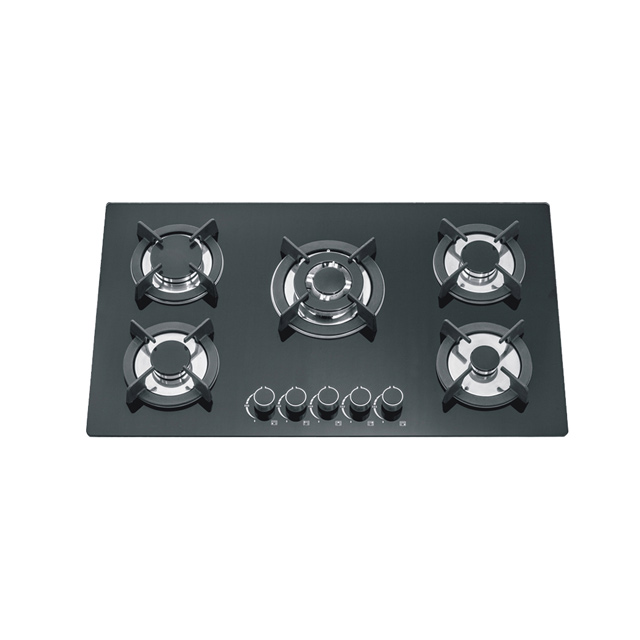
For commercial distributors outfitting luxury kitchens, analyzing the exact spatial dimensions of a 900mm Gas Hob is critical. This specific dimension has become the industry sweet spot. It offers commanding visual appeal while fitting seamlessly into standard cabinetry. Take industry-leading models like the JY-G5053 series as a benchmark. While the glass or steel surface measures exactly 900mm by 510mm, the standard cut-out required hovers around 830mm by 470mm. If a supplier provides cutting templates lacking millimeter precision, property developers face agonizing on-site delays. Countertop fabricators are then forced to halt production to make manual adjustments, bleeding project budgets dry.
The ultimate test of a multi-burner appliance lies in its ergonomic layout. Buyers should rigorously evaluate the distance between the center points of each burner. A poorly engineered unit might group the burners so tightly that the fifth burner becomes entirely unusable when a large stockpot is introduced. Conversely, a strategically spaced layout ensures that a standard 14-inch wok can sit comfortably on the primary burner while four saucepans occupy the perimeter. This prevents structural interference and dangerous heat transfer to the front-mounted control panel.
Not all five-burner configurations are engineered with the same culinary intent. The layout, metallurgical composition, and thermal output must align perfectly with the cooking habits of your target demographic.
The defining feature of a premium setup is the high-output wok burner. Buyers generally choose between two primary configurations. A central wok burner offers symmetrical design and provides maximum clearance for oversized cookware, keeping high flames equidistant from the user. In contrast, placing the high-output burner on the far left or right allows for unimpeded access to the remaining four burners. Look for units delivering at least 3.3kW to 4.0kW on the main wok burner to satisfy modern culinary demands.
The material composition directly impacts operational longevity. Lightweight aluminum burners are cost-effective and resistant to rust, making them highly suitable for mid-tier residential projects. However, for premium market positioning, solid brass burners are vastly superior. Brass possesses exceptional thermal retention, resists corrosion from acidic food spills, and refuses to warp under prolonged intense heat.
In contemporary kitchen architecture, seamless integration is no longer a luxury. It is a baseline consumer expectation. A Built-in Gas Hob delivers this flush, minimalist aesthetic by dropping directly into the countertop. Yet, the surface materials chosen must withstand the daily rigors of heavy cookware while maintaining their showroom appeal.
When selecting surface materials for a container order, buyers must weigh objective pros and cons based on regional preferences. Stainless steel, specifically Grade 304, offers a professional industrial appearance and is virtually shatterproof. This makes it ideal for rental properties. However, buyers must mandate a metal thickness of at least 0.7mm to prevent the chassis from flexing under heavy loads.
On the other hand, tempered glass is highly sought after for luxury developments due to its sleek, reflective finish. The critical metric here is thermal shock resistance. Always insist on 8mm thick glass equipped with an underlying explosion-proof mesh. This engineering detail mitigates shattering risks during extreme temperature fluctuations.
Component | Standard Specification | Premium B2B Specification | Commercial Impact |
|---|---|---|---|
Surface Material | 0.5mm Stainless Steel | 0.7mm+ 304 Steel or 8mm Tempered Glass | Prevents chassis warping under heavy pots; reduces glass shattering claims. |
Pan Supports | Enamel Coating | Heavy-Duty Cast Iron with Rubber Feet | Eliminates sliding hazards and chipping; elevates perceived product value. |
Safety Valves | None or Basic Copper | Orkli Thermocouple FFD | Ensures legal compliance in strict markets; prevents catastrophic gas leaks. |
Control Knobs | Hollow Plastic | Solid Metal Zinc Alloy | Prevents melting from front-burner heat; provides a premium tactile feel. |
Navigating safety compliance is arguably the most critical hurdle in bulk appliance importing. Overlooking these specifications can result in customs seizures, unsold inventory, or severe legal liabilities. Safety is not an optional upgrade. It is a baseline requirement.
A Flame Failure Device utilizing a highly responsive thermocouple is a life-saving mechanism. It automatically severs the gas supply if the burner flame is accidentally extinguished by a sudden draft or a boiling spill. In major markets across Europe, the UK, and Australia, these devices are a strict legal requirement for indoor gas appliances. Bulk buyers must guarantee that every single unit ordered features a certified, factory-tested system.
Simultaneously, evaluate the ignition infrastructure. Battery-operated auto-ignition is incredibly convenient for regions with unstable power grids, requiring no hardwiring. Alternatively, AC-powered ignition delivering 110V or 220V provides a relentless, consistent spark without the need for battery replacements. Beyond the ignition type, assess the tactile quality of the control knobs. Solid metal knobs featuring a push-to-turn mechanism act as an effective child safety lock, preventing the accidental release of gas if bumped by a passerby.
Ultimately, the final comparison extends beyond the physical product to the manufacturing facility producing it. A reliable supplier functions as a strategic, long-term business partner rather than a mere vendor.
For distributors looking to build brand equity, customization is vital. Determine if the supplier offers robust original equipment manufacturing services. Can they seamlessly print your brand logo on the glass, modify packaging for retail display, or adjust internal gas valves to suit specific regional pressures like LPG versus Natural Gas? Furthermore, never authorize a deposit without verifying credentials. Request proof of ISO9001 factory certification and ensure the specific models carry regional product certifications, such as CE or CB testing reports.
Finally, clearly define logistics. Transparent minimum order quantities allow procurement teams to scale orders efficiently without tying up unnecessary capital. Discuss lead times explicitly, tracking the timeline from the moment the deposit clears to the final container loading. A reliable manufacturer operates with streamlined production processes, ensuring your project timelines are met without ever compromising on rigorous quality control.
Smart bulk purchasing demands looking far past the initial price tag. By meticulously comparing the math of material durability, the spatial ergonomics of a 900mm layout, the sleek integration of built-in aesthetics, and the rigorous safety standards of the supplier, buyers can definitively protect their investment. Always partner with a trusted, certified manufacturer to source your next appliance inventory. By utilizing the engineering criteria outlined above, you ensure your end-users receive a product that is as exceptionally reliable as it is beautiful. Ready to elevate your product lineup? Explore high-performance options at Jiaye World to find the exact specifications your next project demands.
While general dimensions frequently hover around 830mm by 470mm, cut-out sizes will vary slightly depending on the specific manufacturer and chassis design. Project managers should always request the finalized physical cut-out template from the supplier before authorizing any countertop fabrication to guarantee a flawless fit.
The decision heavily relies on perceived value and market appeal. A 5-burner setup instantly elevates a standard residential kitchen to chef-grade status. For a relatively marginal difference in wholesale procurement costs, developers can significantly boost the aesthetic appeal and overall property value for potential buyers or high-end tenants.
No, they are highly manageable provided the procurement team selects the correct specifications. Models equipped with 8mm tempered glass, removable heavy-duty cast iron grates, and spill-proof sealed burners prevent food debris from penetrating the internal chassis. This makes daily wipe-downs incredibly simple for the homeowner.
Absolutely. Top-tier manufacturing suppliers offer extensive custom branding services. This infrastructure allows B2B buyers and regional distributors to customize everything from the silk-screened logo on the glass surface to the retail packaging and instruction manuals. This enables you to confidently sell premium products under your own established brand name.
Safety and building codes generally mandate a minimum vertical clearance of 650mm to 750mm between the top of the burner grates and the combustible material or range hood above it. However, because a 5-burner unit often features a high-BTU central wok burner, engineers highly recommend referencing the specific manufacturer guidelines and local fire codes, as high-output units may require clearances closer to 750mm to prevent heat damage to overhead cabinetry.
Yes, the total thermal output of a 5-burner unit is significantly higher than a standard 4-burner model. It requires a gas regulator capable of handling the increased flow rate without causing pressure drops when multiple burners are operating simultaneously. Buyers must specify whether the destination market uses LPG or Natural Gas, ensuring the manufacturer installs the correct factory-calibrated nozzles and supplies the appropriately rated pressure regulator for the bulk shipment.