- All
- Product Name
- Product Keyword
- Product Model
- Product Summary
- Product Description
- Multi Field Search
Views: 0 Author: Site Editor Publish Time: 2026-11-23 Origin: Site

As an engineer who has analyzed countless kitchen appliance failures, I always examine the structural foundation first. Imagine preparing a massive holiday feast. The burners are blazing. Heavy cast-iron pots are shifting across the grates. Your kitchen is a whirlwind of intense activity. In these highly dynamic moments, the absolute last thing you should worry about is the physical integrity of your cooktop.
The modern culinary space demands appliances that deliver brutal functionality alongside stunning aesthetics. Enter the Tempered Glass Hob. It serves as a sleek, glossy centerpiece that effortlessly elevates any countertop. Despite its undeniable visual appeal, a critical question always arises during the selection process. Is a glossy surface truly safe for rigorous, daily open-flame cooking?
Consumers and commercial distributors alike constantly worry whether the panel will shatter under the sheer weight of a Dutch oven. Will it crack when exposed to the intense, localized heat of a 3.3kW triple-ring wok burner? The secret to a secure cooking experience lies entirely in specifying the correct panel depth and verifying the hidden safety features integrated during the manufacturing process. In this technical guide, we will break down the engineering facts. From evaluating structural load capacities to exploring crucial enhancements like thermal resistance and anti-explosion meshes, you will get the objective data required to make a bulletproof decision.
The Engineering Standard: For optimal long-term durability and structural safety, an 8mm thickness is universally recognized by engineers as the gold standard for high-quality hobs. Thinner 6mm panels can suffice, but only for lighter, infrequent usage.
Heat Resistance and Stability: Quality tempered materials are meticulously engineered to withstand severe temperature fluctuations. This specialized treatment prevents the chassis from fracturing or warping during rapid cooling or heating cycles.
Essential Safety Add-ons: Buyers must always prioritize appliances equipped with an anti-explosion mesh, designed to keep fragments completely intact if shattered. Precise perimeter grinding is equally vital to eliminate microscopic edge fractures.
Strategic Market Fit: Commercial buyers need to select specifications based on their target demographic. Premium markets strictly demand 8mm panels, while budget-conscious or compact-living sectors may prefer the cost-efficiency of 6mm options.
To truly appreciate this appliance, we must first look at why it has rapidly replaced traditional metals. The modern kitchen has shifted significantly from purely utilitarian designs to environments that prioritize both function and form. In this architectural transition, glossy cooktops have emerged as the dominant fixture.
Compared to traditional brushed stainless steel, which easily shows scratches, heat discoloration, and stubborn grease stains, glass offers a highly reflective, perfectly smooth surface. This finish seamlessly integrates into minimalist designs. It often sits flush with dark granite or quartz countertops to create a unified, premium look.
From a purely practical standpoint, maintenance drives consumer preference. Picture wiping away a stubborn grease splatter with a single swipe of a microfiber cloth and a mild degreaser. The non-porous nature of the material means that spills and boiled-over liquids simply cannot penetrate the surface. This entirely eliminates the aggressive scrubbing often required for metal crevices.
Structurally, the manufacturing process is what makes this material viable for open-flame cooking. Standard annealed glass is cut to size and heated in a specialized furnace to over 600 degrees Celsius. It is then rapidly cooled in a precise process known as quenching. This rapid cooling forces the outer surfaces to contract and compress while the interior remains in tension. This engineered stress profile makes the final product up to five times stronger than regular, untreated glass.
Recent market data and engineering analyses reveal a massive shift in appliance manufacturing. Builders and homeowners are moving away from entry-level specifications toward thicker, heavy-duty appliances. As open-plan kitchens become the architectural norm, the cooktop serves as a central design element rather than just a utilitarian tool.
Specifically, we are witnessing a definitive transition in burner technology. Modern homes now demand professional-style cooking power. When you introduce high-efficiency wok burners and heavy cast-iron pan supports into a residential kitchen, the thermal and mechanical stress on the chassis multiplies exponentially. Consequently, the industry standard is migrating rapidly. B2B distributors and informed consumers are now demanding 8mm panels over the traditional 6mm baseline. This upgrade is no longer viewed as a premium luxury. It is an engineering necessity for accommodating heavy cookware and high-BTU outputs safely.
When evaluating a new cooktop on the assembly line or in a showroom, the Glass Thickness is not merely an upsell feature. It is the foundational metric that dictates the appliance's safety, longevity, and overall performance.
The primary physical stress on any hob comes directly from the cookware. The depth of the panel directly correlates to its static load-bearing capacity. A kitchen frequently utilizing heavy cast-iron skillets or massive stockpots filled with boiling water places immense downward pressure on the surface. Thicker material distributes this weight much more evenly across its structural matrix. This even distribution prevents localized stress fractures from forming under the burner grates.
Furthermore, cooking is a highly dynamic activity. Utensils drop. Heavy pans slam down repeatedly. Vigorously boiling liquids create continuous micro-vibrations that transfer directly into the appliance's chassis. Thicker panels possess a higher mass and density. This allows them to absorb and dissipate the kinetic energy from accidental impacts much more effectively than thinner alternatives. A thin panel remains far more susceptible to cracking from a concentrated point of impact, such as the sharp edge of a dropped metal spatula.
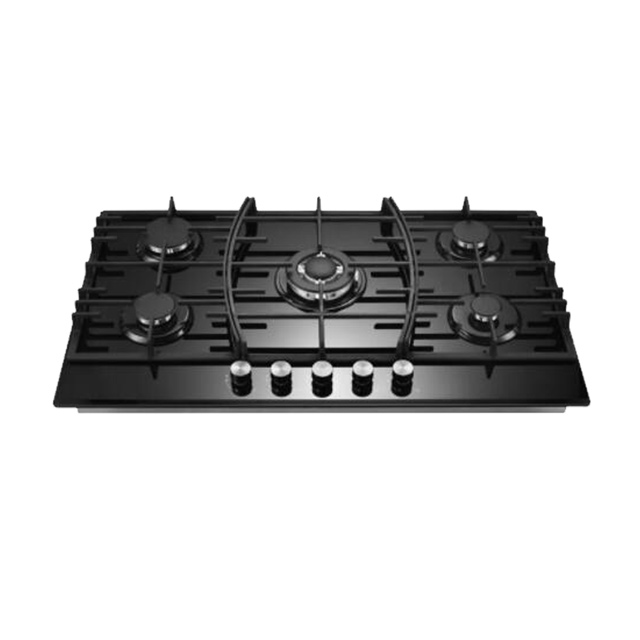
Take a large 900mm wide 5-burner setup like the JY-G5085 model. It features massive cast-iron pan supports designed for serious culinary work. In these expansive layouts, going thinner than 8mm presents a severe structural liability. The wider the span, the more rigidity the chassis requires to prevent sagging or shattering under a full load.
Choosing between a 6mm and an 8mm panel requires an objective assessment of cooking habits, budget constraints, and long-term durability expectations. Both options serve distinct consumer needs, but they perform very differently under stress.
The primary advantage of a 6mm panel is its initial cost-effectiveness. It uses less raw material, making it more affordable to manufacture, ship, and retail. It is significantly lighter, which simplifies handling and installation for contractors. For everyday light-to-medium cooking, such as boiling pasta, frying eggs, or simmering sauces in standard aluminum pans, a 6mm hob is entirely adequate. However, the trade-off is a sharply reduced tolerance for heavy impacts. Under extreme, sustained commercial-level heat, a 6mm panel exhibits a slightly higher risk of warping or developing stress cracks over years of use.
In contrast, an 8mm panel offers maximum residential durability. It boasts a substantially higher resistance to heavy static weights and dynamic impacts. The thicker material provides superior thermal mass. This aids in better heat distribution and insulation, keeping the underside of the hob and the cabinetry below much cooler. While the initial retail cost is higher, the investment pays off immediately in longevity and a sturdier, more premium tactile feel.
Engineering Feature | 6mm Tempered Panel | 8mm Tempered Panel |
|---|---|---|
Dynamic Impact Resistance | Moderate | Exceptionally High |
Static Load Capacity | Suitable for standard aluminum pots | Engineered for heavy cast iron and large stockpots |
Thermal Stability | Good | Superior heat dissipation |
Market Positioning | Budget to Mid-range projects | Premium Residential Investment |
Ideal Application | Apartments, light daily cooking | Large families, 900mm 5-burner layouts |
Beyond physical impact, the most significant threat to any glass cooktop is a sudden, violent temperature fluctuation. In materials engineering, this phenomenon is scientifically referred to as Thermal Shock.
Imagine you are boiling a large pot of pasta. The starchy, ice-cold water suddenly boils over, spilling directly onto a surface that has been intensely heated by adjacent gas burners. The localized cooling causes the affected area to contract violently, while the surrounding hot material remains fully expanded. In standard, untreated glass, this opposing mechanical stress instantly causes the panel to shatter into pieces.
The specialized tempering process specifically fortifies the appliance against this exact scenario. Because the exterior is already in a state of high compressive stress, it can effortlessly withstand the tensile forces generated by sudden cooling. High-grade panels are rigorously tested in laboratories to withstand temperature differentials of up to 300 degrees Celsius. This strict testing ensures that even during prolonged, high-heat cooking sessions, accidental spills of cold liquids will never result in catastrophic failure.
Even with the correct thickness and extreme thermal resistance, the inherent nature of the material requires additional engineering fail-safes. Two critical manufacturing refinements separate premium, reliable appliances from dangerous, substandard ones.
In the physics of glass, the perimeter is always the most vulnerable point. Microscopic chips, manufacturing flaws, or uneven cuts along the edge act as massive stress concentrators. If the surface expands due to heat, these microscopic flaws can rapidly propagate into macroscopic cracks, leading to spontaneous shattering. High-quality Edge Polishing completely mitigates this risk. By grinding the raw edges into a perfectly smooth, beveled, or rounded finish, manufacturers remove these microscopic imperfections. This single step fundamentally increases the structural stability of the entire panel.
Despite all precautions, extreme and concentrated impacts can still cause breakage. Drop a heavy meat tenderizer directly onto the surface from a height, and physics will take over. If the worst occurs, the material is designed to crumble into small, blunt, pebble-like pieces rather than lethal sharp shards. To prevent these blunt pieces from scattering across the kitchen floor, premium manufacturers apply a high-tensile polymeric Safety Film to the underside of the panel. This layer acts as a permanent adhesive backing. It holds the shattered pieces firmly in place so the hob remains safely intact as a single sheet until a technician can replace it.
The decision-making process for selecting product specifications varies significantly depending on whether the purchaser is an end-user or a commercial distributor.
Homeowners must prioritize daily usability, family safety, and seamless aesthetic integration. A residential buyer should always focus on longevity by upgrading to an 8mm panel. This ensures the appliance will survive the unpredictable rigors of family life. Verifying the presence of automatic flame failure devices and explosion-proof backing is absolutely non-negotiable for a secure household environment.
For B2B buyers, wholesalers, and project contractors, the calculation revolves around balancing profit margins with product reliability and brand reputation. Stocking 8mm hobs with polished edges drastically reduces return rates and warranty claims. Fewer complaints regarding shattered surfaces directly protect the distributor's bottom line. By explicitly marketing these hidden engineering features, distributors build immense brand trust. They can easily outshine competitors who import cheaper, uncertified 6mm alternatives that fail in the field.
To ensure a safe and highly satisfactory purchase, follow this objective evaluation process before upgrading your kitchen or product catalog:
Begin by measuring the precise cutout dimensions of your kitchen counter. Match the hob size, ranging from 60cm to 90cm, to the physical layout and the household's cooking demands. Ensure the distance between the burners easily accommodates the diameter of the oversized cast-iron pots you frequently use. A cramped layout leads to heat overlapping, which stresses the glass.
Do not rely solely on visual inspection or highly edited marketing photos. Always check the manufacturer's technical specification sheet to confirm the exact depth. Ensure it is an absolute minimum of 6mm. For primary residences that see heavy daily use, demand an 8mm specification.
A reputable appliance will have its safety credentials clearly documented. Look for explicit proof of thermal endurance testing. Confirm the inclusion of an integrated anti-explosion layer on the underside. Run your fingers carefully along the perimeter to verify smooth, professional edge grinding. Rough edges are a massive red flag.
The design of the burners directly impacts the longevity of the surface beneath them. Ensure that the brass or aluminum alloy burners are engineered to direct the gas flame strictly upwards and outwards toward the base of the cookware. Poorly designed burners that deflect excessive heat downwards will cause localized overheating. This significantly increases the risk of thermal stress fatigue over time.
A glossy cooktop is a fantastic, modern addition to any kitchen, provided you prioritize engineering safety and build quality over the absolute lowest price tag. It offers a sophisticated aesthetic paired with reliable daily function, completely transforming the way you interact with your culinary space.
For ultimate peace of mind, maximum longevity, and robust performance, an 8mm thickness equipped with proper perimeter polishing and an anti-explosion mesh is the superior choice. These features work in tandem to protect your family during intensive daily cooking, ensuring your kitchen remains both beautiful and structurally secure. Ready to upgrade your product lineup or residential kitchen? Stop gambling with substandard materials. Choose engineering excellence and certified safety. Explore the robust, high-performance collections at Jiaye World to find the perfect match for your specific market demands.
Yes, absolutely. From an engineering standpoint, an 8mm panel offers superior thermal mass, significantly better impact resistance, and safely supports heavier cast-iron cookware. While 6mm is acceptable for light duty, 8mm provides the structural rigidity required for intense, daily cooking without the risk of warping or stress fractures.
A high-quality 8mm panel paired with sturdy, well-designed cast-iron pan supports can safely hold 25 to 30 kilograms of static weight. This easily accommodates large stockpots filled with water and heavy Dutch ovens, provided the weight is placed gently and distributed properly across the grates.
While incredibly rare, spontaneous breakage can occur due to microscopic impurities during manufacturing, such as nickel sulfide inclusions, or from unpolished edge damage that weakens the panel over time. Choosing an 8mm thick model with proper perimeter polishing minimizes this risk drastically. Ensuring the appliance has a built-in anti-explosion mesh guarantees that even if a break happens, the fragments remain entirely contained.
A 6mm panel is structurally safe for standard, lightweight daily use. However, if you regularly use heavy cast-iron cookware, utilize oversized stockpots, or cook for large families using multiple high-heat burners simultaneously, a 6mm surface will experience excessive mechanical stress. Upgrading to an 8mm thickness offers much greater peace of mind for intensive culinary tasks.
Patience is key. Always wait for the burners and the surface to cool completely before cleaning to avoid inducing rapid temperature changes. Use a soft microfiber cloth, warm water, and a non-abrasive liquid cleaner to wipe away grease. Strictly avoid using steel wool, harsh scouring pads, or abrasive chemical powders, as these will create micro-scratches that compromise structural integrity and dull the glossy finish.
Ceramic panels are specifically formulated to withstand direct, extreme heat and are typically utilized for electric radiant or induction cooktops. Because of their complex manufacturing process, they are significantly more expensive. Tempered panels are the industry standard for gas appliances. They are highly resistant to ambient heat and physical impact, much more affordable, and feature a distinct, reflective glossy finish that beautifully enhances modern kitchen aesthetics.