- All
- Product Name
- Product Keyword
- Product Model
- Product Summary
- Product Description
- Multi Field Search
Views: 0 Author: Site Editor Publish Time: 2026-11-11 Origin: Site

Kitchen safety dictates strict engineering controls long before an appliance ever reaches a residential site. Consider peak load conditions in a modern kitchen. Multiple burners fire simultaneously. Ambient heat rises rapidly. Cross-drafts sweep through as doors open, and pots occasionally boil over. Equipment must handle this mechanical and thermal stress safely. The EN 30 standard serves as the primary European benchmark for domestic cooking appliances burning gas. This comprehensive regulatory framework acts as the ultimate gatekeeper for appliance safety, energy efficiency, and user health. It provides a uniform testing methodology that manufacturers must strictly adhere to before legal distribution.
Consumers and industry professionals often ask about the specific testing parameters required for certification. The reality is that this standard is not a single monolithic test. It is a highly detailed series of specific clauses. Each section evaluates a distinct operational parameter. This article breaks down these critical testing phases. We will explore how leak prevention, structural integrity, and exhaust emissions are scientifically evaluated to keep modern kitchens compliant and secure.
The Gold Standard of Safety: The EN 30-1-1 document is the primary European regulatory standard governing the operational safety of domestic gas cooking appliances.
Multiple Clauses for Complete Verification: There is no single test. Specific sections systematically evaluate gas soundness, thermal output, and chemical emissions.
Zero Tolerance for Leaks: Strict laboratory protocols guarantee the internal gas circuit is completely sealed to prevent hazardous residential buildup.
Aerodynamic Flame Control: Empirical testing ensures flames do not lift off the burner head or flash back into the appliance body during drafts or pressure drops.
Protecting Indoor Air Quality: The standard mandates rigorous limits for toxic emissions to ensure daily cooking does not compromise respiratory health.
The regulatory framework is intelligently divided into specialized parts to address different aspects of appliance performance. EN 30-1-1 serves as the foundational technical document detailing general safety requirements. It dictates the physical construction, material durability, and essential mechanical safeguards. These rules prevent accidents, fires, and toxic exposure. Specifically, the document outlines how an appliance must behave under both normal conditions and extreme mechanical stress.
In contrast, EN 30-2-1 focuses strictly on the rational use of energy. It outlines the methodologies used to determine the thermal efficiency of the burners. This ensures the cooktop transfers heat to the cooking vessel effectively. Minimizing fuel waste during daily operation is a core objective. Together, these two documents form the baseline for both household safety and environmental sustainability in manufacturing.
Furthermore, the regulatory landscape is rapidly shifting toward stricter environmental controls. European gas networks are actively preparing for hydrogen blending. Modern testing protocols increasingly account for fuel mixtures containing up to 20 percent hydrogen. This shift forces engineers to rethink burner geometries, as hydrogen burns hotter and faster than traditional natural gas. Consequently, manufacturers are heavily investing in computational fluid dynamics to optimize aeration. The primary engineering goal is to maintain exceptionally low nitrogen oxide emissions while ensuring backward compatibility with existing municipal grids.
Navigating the official documentation reveals a highly structured approach to hazard prevention. While the standard contains numerous sections regarding construction materials, the core operational evaluations are found later in the text. Clause 6 is the primary section covering safety of operation. It evaluates physical behaviors like surface temperatures, ignition reliability, and flame mechanics. Meanwhile, Clause 7 is strictly dedicated to the analytical chemistry of exhaust gases.
EN 30 Clause | Testing Parameter | Engineering Focus | Real-World Benefit |
|---|---|---|---|
Clause 6.1.3 | Gas Soundness | Valve and manifold integrity | Prevents explosive gas buildup inside cabinetry |
Clause 6.3 | Flame Stability | Aerodynamic resilience | Stops flames from blowing out during cross-drafts |
Clause 7.1 | Combustion Quality | Oxygen mixing efficiency | Protects indoor air quality from Carbon Monoxide |
Clause 6.1.6 | Temperature Limits | Heat transfer to chassis | Prevents contact burns on user control knobs |
A formal Gas Hob Test does not take place in a standard kitchen setup. It occurs in highly controlled, accredited laboratory environments. Variables such as ambient temperature, humidity, and atmospheric pressure are strictly monitored. Technicians utilize specialized reference gases to simulate the optimal fuel composition. They also use limit gases formulated to mimic extreme variations in municipal grid pressure and chemical makeup. This empirical methodology ensures the equipment remains safe even if the local residential gas supply fluctuates unexpectedly.
Before a technician ever ignites a burner, the structural integrity of the internal piping must be absolutely verified. Gas leaks present the most immediate and catastrophic danger in any residential setting. Even a microscopic defect in a brass valve, a loose pipe joint, or a faulty manifold can allow volatile organic compounds to accumulate silently. This creates severe risks of explosive ignition or asphyxiation. Verifying structural soundness is always the foundational step in the compliance process.
Specifically, the procedures for evaluating gas soundness are detailed in the early sections of Clause 6. During this phase, laboratory technicians perform a rigorous Leak Test on the unit's entire internal pathway. They connect the cooktop to a pneumatic testing rig. This rig pressurizes the internal circuit with air or an inert gas to a level significantly higher than standard household operating pressure.
Once pressurized, highly sensitive digital manometers monitor the sealed system. They check for any pressure drop over a specified time duration. A registered drop mathematically indicates a leak. If the pressure remains perfectly constant, it objectively proves that the valves and seals safely contain the fuel supply. If an appliance fails this stage, testing halts immediately.
In addition to structural integrity, aerodynamic resilience is critical. Two primary hazards monitored during operation are flame lift and flashback. Flame lift occurs when the velocity of the unburned gas mixture exceeds the burning velocity. This causes the base of the flame to physically detach from the burner ports. The fire can blow out entirely, continuously releasing raw gas into the room.
Flashback is the opposite phenomenon. It happens when the burning velocity exceeds the flow rate. The combustible mixture ignites internally and travels backward into the burner body or mixing tube. Incorrect supply pressure, sudden ambient cross-drafts, or mathematically flawed burner geometry typically trigger these hazardous events.
To prevent these terrifying scenarios, technicians conduct Flame Stability tests under Clause 6.3. They subject the appliance to rigorous aerodynamic trials. Engineers operate the burners using limit gases to formulate conditions likely to induce failure. The unit is tested at normal, abnormally high, and abnormally low gas pressures.
Furthermore, calibrated laboratory fans introduce artificial cross-drafts. This simulates an open window or rapid human movement nearby. To pass this stringent clause, the fire must remain steadily anchored to the burner cap. It cannot lift, extinguish, or retreat into the internal piping.
While a stable blue flame is visually reassuring, invisible exhaust gases require strict regulation. The Combustion testing requirements in Clause 7 govern the acceptable chemical limits of the exhaust plume. During this evaluation, the unit operates at maximum thermal input. Specialized collection hoods and digital gas analyzers capture the emissions.
The standard sets non-negotiable maximum concentration thresholds for toxic byproducts, primarily Carbon Monoxide. If the burner design fails to mix ambient oxygen and fuel efficiently, incomplete combustion occurs. This leads to elevated CO levels that violate the standard. Achieving low emission rates proves the engineering is sound for enclosed spaces.
The technical limits established in the laboratory directly correlate to human health. Prolonged exposure to elevated CO levels causes respiratory distress, chronic headaches, and severe long-term complications. By passing these chemical analysis tests, a certified unit demonstrates clean operation by design. Paired with proper mechanical kitchen ventilation, these appliances systematically mitigate respiratory risks.
Appliance safety extends far beyond the open fire itself. Specific clauses dictate the maximum allowable temperatures for exterior components. During prolonged operation at maximum thermal capacity, testers utilize thermal sensors. They measure the heat transferred to the front control panels, user knobs, and surrounding installation countertops.
If these touchable surfaces become too hot, they pose an immediate burn risk. The standard ensures all interface parts remain within strict thermal limits. This eliminates the risk of accidental contact burns or the ignition of adjacent wooden cabinetry.
Modern European safety standards mandate the inclusion of a Flame Failure Device on all indoor gas cooking equipment. This crucial thermocouple-based component automatically shuts off the main supply valve if the fire accidentally extinguishes. During testing, laboratory technicians intentionally blow out the active flame. They measure the exact time it takes for the mechanism to cool down and engage the shut-off valve. The device must cut the flow swiftly, usually within a strict limit of 60 to 90 seconds.
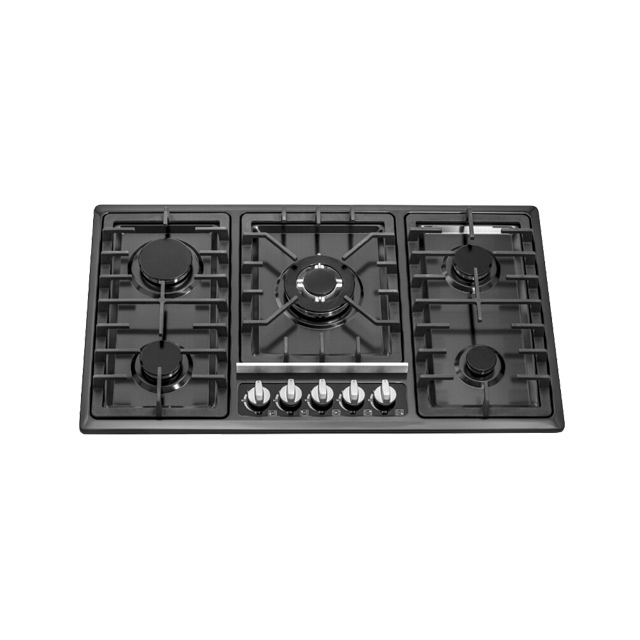
How do you translate these rigorous lab tests into practical procurement decisions? When selecting equipment for a residential or commercial project, look beyond the basic CE mark. Evaluate the engineering specifications directly tied to EN 30 compliance. For instance, an 860mm Black Stainless Gas Hob designed for high-capacity cooking must feature robust construction. Look for heavy-duty cast iron pan supports and precision-machined brass burner caps. These components ensure the flame geometry remains stable under heavy thermal loads.
Verify the thermal input ratings. A high-efficiency wok burner delivering 3.3kW or more requires optimized aeration channels to pass the stringent emission limits. Ensure the unit chassis utilizes reinforced tempered glass or high-grade stainless steel to manage heat transfer effectively. Selecting a properly specified model guarantees the equipment has passed the rigorous leak, stability, and emissions evaluations.
Failure during any single phase of the testing sequence carries immediate commercial consequences. The product cannot be legally sold, distributed, or installed in regions requiring CE marking. Manufacturers must return the unit to the engineering design phase to rectify the specific failure point.
This iterative process may involve redesigning the brass burner caps to improve aeration. Engineers might upgrade internal manifold valves to pass pressure tests or recalibrate flow rates to achieve cleaner exhaust. Only after completing these physical modifications can the appliance undergo the entire rigorous testing sequence again from the beginning.
The safety of a modern cooking appliance is not determined by a single simple check. It relies on a rigorous suite of EN 30 clauses. From the foundational leak verifications that prevent hazardous buildup, to aerodynamic stability trials and strict chemical emission limits, every operational aspect is scrutinized. These stringent European standards protect both the user's immediate physical safety and long-term respiratory health. When upgrading a kitchen, always verify proper certification marks. For high-quality, fully certified cooking equipment that meets these demanding engineering standards, explore the professional range of gas hobs at Jiaye World to ensure ultimate safety and performance in your home.
EN 30 is a comprehensive set of European safety and performance standards specifically written for domestic cooking appliances that burn gas. It establishes uniform testing methodologies to ensure products meet strict safety, efficiency, and health benchmarks before entering the consumer market.
Gas soundness is typically evaluated under the operational safety requirements found in Clause 6. This phase uses pressurized air or inert gas to verify that all internal valves, pipes, and joints are completely sealed and free of defects.
Flame stability ensures the fire remains safely attached to the burner head under varying environmental conditions. If a flame lifts off the burner, it can extinguish and release raw gas into the room. Stability testing guarantees the unit handles ambient drafts and supply pressure changes safely.
Yes. The combustion clauses strictly test the exhaust gases produced during active operation. Laboratory analyzers measure the exact concentration of combustion byproducts. The appliance must not exceed specific maximum thresholds for toxins like carbon monoxide to ensure safe indoor air quality.
Appliances that successfully pass all required testing protocols will feature a CE mark or UKCA mark permanently affixed to their data plate. The accompanying user manual and technical documentation will explicitly state the appliance's conformity with relevant regional safety directives.
EN 30-1-1 focuses entirely on the operational safety of the appliance, covering aspects like leak prevention, flame stability, and surface temperatures. EN 30-2-1 focuses on energy efficiency, detailing the testing methods used to calculate how effectively the burners transfer heat to the cooking vessel.
Manufacturers must test a gas hob model during the initial product development and certification phase before it enters the market. Once a model is certified, it does not need re-testing unless the manufacturer alters the design, changes core components, or updates the manufacturing process in a way that could affect performance or safety.