- All
- Product Name
- Product Keyword
- Product Model
- Product Summary
- Product Description
- Multi Field Search
Views: 0 Author: Site Editor Publish Time: 2026-09-12 Origin: Site

The modern kitchen appliance market is highly competitive. B2B buyers face complex procurement decisions every day. Sourcing directors often overlook critical safety and durability parameters. This oversight leads to expensive post-installation maintenance. Are you struggling to find reliable, versatile cooking solutions for large-scale property developments? Understanding the intricate engineering behind a hybrid cooktop is essential. This technical guide breaks down exactly what matters when evaluating specifications for a Gas Electric Hob. We will ensure your next procurement cycle relies on hard data and industry best practices.
Hybrid Efficiency: Combining the rapid heat of gas with the consistent performance of electric zones creates a highly adaptable appliance for diverse consumer markets.
Material Durability: Specifying high-grade metal chassis ensures exceptional resistance to corrosion and thermal shock. This optimizes long-term return on investment for OEM projects.
Optimal Configurations: A standard four-zone layout maximizes utility within standard counter dimensions. It hits the structural sweet spot for residential kitchen designs.
Safety is Paramount: Institutional buyers must demand strict safety mechanisms. Flame Failure Devices, residual heat indicators, and mandatory regional certifications are non-negotiable.
Customization Matters: Partnering with a capable manufacturer allows for tailored branding, ergonomic knob designs, and specific power calibrations to match local infrastructure.
Market data reveals a distinct pivot in commercial kitchen procurement. Developers are rapidly moving away from single-fuel dependency. Global energy grids are currently experiencing unprecedented volatility. Consequently, energy-resilient hybrid appliances are becoming the new standard. Real estate projects now demand appliances that pair traditional gas burners with high-efficiency electric zones. This dual-fuel approach safeguards end-users against utility fluctuations. Furthermore, it aligns perfectly with modern green building mandates.
Supplying appliances with built-in redundancy is a massive commercial advantage. If a region experiences rolling blackouts, gas burners ensure cooking continues uninterrupted. Conversely, if a household runs out of bottled gas, the electric hotplate serves as an immediate backup. This reliability builds long-term brand trust in regions with unstable infrastructure. It directly reduces consumer frustration and lowers after-sales service calls.
Modern kitchen projects must cater to a wide array of culinary habits. Imagine a mid-tier residential complex where tenants have vastly different cooking routines. Some methods require the immediate searing capabilities of an open flame. Other techniques benefit from the steady simmering provided by an electric hotplate. By specifying a dual-fuel appliance, procurement managers offer a comprehensive solution. This adaptability allows end-users to switch energy sources based on specific meal requirements. Ultimately, installing appliances with this level of versatility directly increases the perceived value of the property.
Thermal efficiency is a critical metric when evaluating factory specifications. Heat output is typically measured in kilowatts or British Thermal Units. A well-engineered hybrid unit features a precise combination of burner sizes. This accommodates different cookware and cooking techniques.
Auxiliary Burner: Rated at 1.0 kW. Designed for small pots or gentle simmering.
Semi-Rapid Burner: Rated at 1.75 kW. The standard workhorse for everyday cooking tasks.
Rapid Burner: Rated at 3.0 kW. Ideal for boiling water quickly.
Wok Burner: Rated between 3.3 kW and 4.0 kW. Features a multi-ring flame engineered for heavy stir-frying.
Procurement teams must ensure total gas consumption aligns with regional safety regulations. Internal brass valves must provide linear flame control. Abrupt step-changes in heat indicate poor valve engineering.
The electric portion of the appliance requires equally rigorous evaluation. Sourcing directors must choose the appropriate heating technology based on budget and target market habits.
Solid Cast Iron Hotplates: The most traditional and cost-effective option. Standard power ratings range from 1000W to 1500W. They are highly durable and retain heat well.
Radiant Ceramic Zones: These utilize heating elements beneath a flat ceramic glass surface. They heat up faster than solid plates and offer a sleeker aesthetic.
Induction Zones: The pinnacle of energy efficiency. They utilize electromagnetic fields to heat cookware directly. They offer unparalleled speed and safety but require magnetic pans.
Feature | Single-Fuel Gas | Single-Fuel Electric | Hybrid Cooktop |
|---|---|---|---|
Energy Resilience | Fails during gas shortages | Fails during power outages | High built-in redundancy |
Cooking Versatility | High heat open flame | Steady ambient heat | Optimal caters to all methods |
Installation Complexity | Requires gas line | Requires dedicated circuit | Requires both utility connections |
OEM Project Suitability | Standard | Standard | Premium higher property value |
Appliance longevity directly impacts profitability in large-scale property management. A Stainless Steel Hob is the industry benchmark for mechanical durability. Tempered glass carries a risk of shattering under extreme thermal shock or heavy blunt impact. In contrast, high-grade metal absorbs impact without catastrophic failure. Quality alloys offer excellent resistance to rust and oxidation. Specifying a panel thickness of 0.6mm to 0.8mm prevents chassis warping under heavy cookware. This is particularly vital in commercial environments subjected to rigorous daily use.
Brushed or polished metal integrates flawlessly into modern minimalist apartments. It matches other standard appliances, creating a cohesive visual flow. These surfaces are straightforward to clean with standard commercial degreasers. They do not require specialized glass cleaners. For property managers, this ease of maintenance directly translates to fewer tenant complaints.
When scaling up production, material costs must be strictly managed. Metal chassis are more cost-effective to manufacture in bulk than high-end ceramic glass panels. Glass demands specialized cutting, tempering, and edge-beveling processes. Selecting durable metal allows procurement managers to allocate budget toward functional internal upgrades. You can invest in heavier cast-iron pan supports while maintaining a competitive unit price.
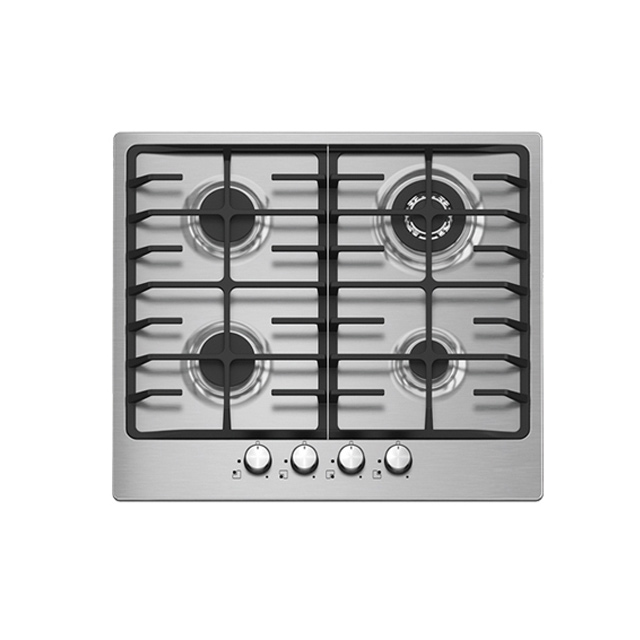
The layout of heating zones is a primary strategic decision. The 4 Burner Hob remains the most popular configuration globally. It offers sufficient cooking capacity without demanding oversized custom cabinetry. Two dominant layouts exist within this category.
The balanced layout features two gas burners and two electric zones. This is ideal for markets where energy grid reliability is highly unpredictable. It provides a true even backup system. Conversely, the gas-dominant layout features three gas burners and a single electric hotplate. This setup is highly favored in regions where gas is the preferred utility. The single electric plate is retained specifically for slow simmering or as an emergency backup.
Space is a premium commodity in modern urban housing. A standard 60cm four-zone layout maximizes the active cooking area. It minimizes the appliance footprint on the countertop. Wider 90cm models require custom cabinetry and larger extractor hoods. The 60cm configuration fits perfectly into standard flat-pack kitchen units. This standardization empowers property developers to streamline supply chains. Using uniform countertops reduces overall construction costs across hundreds of units.
Safety is an area where compromises cannot be made. Importing appliances lacking mandatory safety features leads to severe legal liabilities. Specific mechanisms must be explicitly demanded during factory negotiations. The Flame Failure Device is a critical thermocouple technology. If a gust of wind extinguishes the flame, the thermocouple detects the temperature drop. It automatically shuts off the gas valve within seconds. This prevents dangerous gas accumulation.
Additionally, residual heat indicators are vital for electric zones. They warn users that the surface remains dangerously hot after powering down. Built-in electronic auto-ignition eliminates the need for external lighters. This keeps the user hands safely away from the initial combustion flare. Standard ignition systems utilize a 220V AC pulse for instant lighting.
A reputable supplier must prove compliance with international safety standards. Sourcing teams should request proof of CE Marking for the European market. The CB Scheme is necessary for global electrical component safety. RoHS Compliance ensures the appliance is free from hazardous materials like lead. Furthermore, an ISO 9001 certification indicates the manufacturing facility maintains a rigorous Quality Management System.
Working with a factory partner provides the ability to customize products. Aesthetic tweaks significantly elevate the perceived value of the final unit. Buyers can specify the material of control knobs. Options range from economical heat-resistant Bakelite to premium solid metal. Pan supports are another critical touchpoint. Enamel grids are lightweight and cost-effective. Heavy-duty cast-iron supports offer superior stability and a professional look. Manufacturers can also utilize laser-etching technology. This permanently engraves your company logo onto the chassis.
A successful rollout must be technically adapted to the destination country. The appliance must be calibrated at the factory for specific fuel types. This means configuring for either piped Natural Gas or cylinder Liquefied Petroleum Gas. High-quality orders always include conversion kits in the packaging. This allows certified technicians to switch the fuel type on-site. Voltage requirements also vary globally. The manufacturer must configure heating elements for either 110V or 220V, complete with the correct regional plug.
The success of a bulk procurement project hinges on delivery timelines. Buyers must deeply assess factory production capacity. This involves reviewing active assembly lines and automated metal stamping capabilities. A factory with robust capacity can absorb large seasonal orders without extending standard lead times. Standard lead times typically range from 30 to 45 days for customized units.
Stringent Quality Control separates a reliable manufacturer from a risky liability. Buyers should actively inquire about Standard Operating Procedures. Crucially, the facility must conduct pneumatic gas leak testing on every unit. High-potential dielectric strength testing on electrical components is also mandatory. A dedicated Research and Development team indicates the factory can integrate new energy-efficient technologies to meet bespoke client requests.
Procurement terms must be carefully negotiated. Minimum Order Quantities for customized appliances typically range from 100 to 500 units per model. This depends heavily on the bespoke tooling required. Beyond the initial purchase, buyers must secure an agreement for after-sales support. A standard contract should include a provision for free spare parts. This is usually one to two percent of the total order volume. Covering critical wear-and-tear components like thermocouples and ignition modules mitigates exorbitant warranty costs.
Choosing the right hybrid cooking appliance is a multifaceted engineering process. It demands a careful balance of thermal performance, durable materials, and optimal spatial layouts. The technical specifications are ultimately only as reliable as the manufacturer executing them. Prioritize stringent safety standards and demand rigorous factory quality control. Leverage smart customization options to safeguard your investment. Partnering with seasoned industry experts ensures your next large-scale kitchen project provides long-lasting value to the end-user. Ready to upgrade your OEM appliance portfolio? Explore premium manufacturing options and secure your supply chain by visiting Jiaye World today to find the exact specifications your project demands.
Yes, customizing the burner ratio is a standard offering from reputable factory partners. A symmetrical two-gas and two-electric layout is common for residential projects. However, the layout can be tailored to specific market demands. Procurement teams can request a three-gas and one-electric configuration based on available chassis molds.
High-grade metal surfaces are universally recommended by developers for high-turnover environments. The primary advantage is exceptional mechanical durability. Metal is highly resistant to impact damage from dropped cookware. It withstands abrasive cleaning agents better over a long period, resulting in significantly fewer maintenance requests.
These appliances can be engineered to operate on either Natural Gas or Liquefied Petroleum Gas. The distinction lies in internal pressure requirements and the specific size of the brass injectors. Quality manufacturers configure the appliance based on your destination market. They typically include certified conversion kits within the packaging.
The minimum order quantity varies based on the level of customization. Fully customized orders requiring bespoke metal stamping and unique knob designs generally start between 100 to 500 units. If a buyer selects a pre-engineered factory model and only requires superficial customization like laser-etching, manufacturers may accept lower volumes.
Cookware requirements depend entirely on the specific heating technology. Standard solid cast-iron hotplates or radiant ceramic elements work with any standard flat-bottomed cookware. If the zone utilizes induction technology, the end-user must use ferromagnetic cookware such as cast iron or magnetic stainless steel.
Proper ventilation is mandatory due to the combustion of gas. A range hood or extractor fan must be installed directly above the appliance. The extraction rate should match the total kilowatt output of the gas burners. Local building codes dictate the exact clearance height, typically between 65cm and 75cm above the cooking surface.
Maintenance is straightforward but requires separate approaches for different zones. The stainless steel chassis should be cleaned with non-abrasive commercial degreasers to prevent scratching. The cast-iron electric hotplates benefit from occasional seasoning with a light coat of cooking oil to prevent rust. Always ensure the appliance is completely cooled and disconnected from power before deep cleaning.